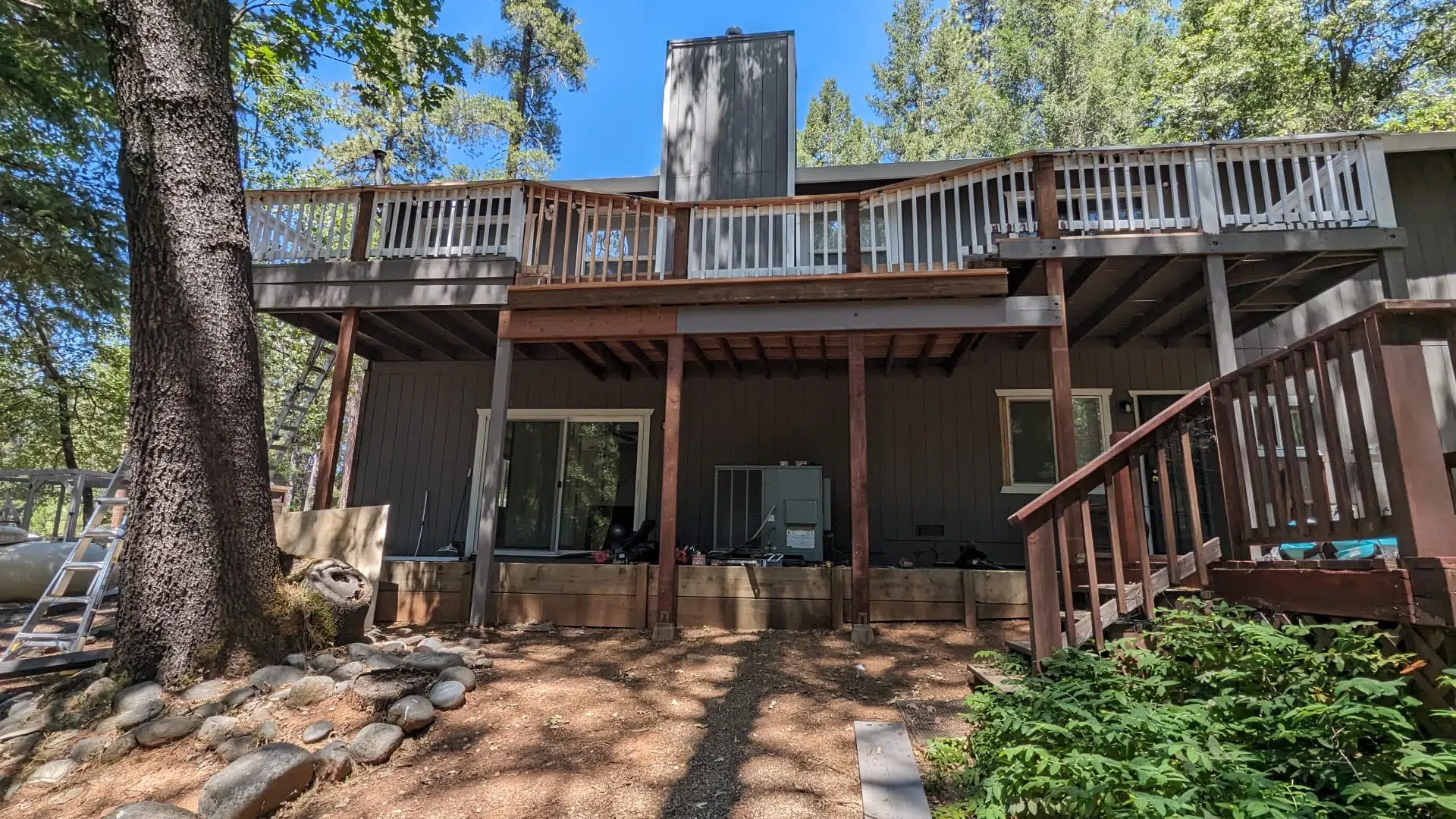
Sacramento Deck Decision Guide
A weathered deck is not automatically a teardown. A clean-looking deck is not automatically safe. The real question is whether the deck’s structural core—from the ledger and joists to the posts and footings—still provides a trustworthy load path.
This guide explains how the decision is made. It is not a remote safety inspection or engineering opinion. A deck with movement, a loose guard, a pulling ledger or visibly failed support should be kept out of service until evaluated.

The Short Answer
When Can a Deck Be Repaired Instead of Rebuilt?
Repair is a reasonable path when deterioration is localized, the primary structure can be inspected, and the remaining ledger or support system, joists, beams, posts and footings are sound enough to keep. Rebuilding becomes the safer and more predictable choice when damage or movement runs through several parts of the load path—or when so much framing must be replaced that the old deck no longer provides meaningful value.
A deck may be a repair candidate when
- surface damage is limited to boards, trim or a small area;
- one or a few framing members are affected but adjacent wood is sound;
- posts, beams and footings are stable and serviceable;
- the ledger connection can be verified—or the deck is independently supported;
- limited hardware defects can be corrected in sound wood;
- the moisture source can be fixed as part of the same scope.
Rebuilding deserves serious consideration when
- decay affects multiple joists, beams, posts or connections;
- the ledger or house rim is deteriorated, pulling away or cannot be trusted;
- footings have moved, settled or no longer provide reliable support;
- corrosion is widespread rather than isolated;
- several members are undersized, over-spanned or poorly connected;
- a roof, hot tub, outdoor kitchen or major redesign will add new loads.
Do not make the decision from the walking surface alone. Worn boards can sit on a repairable frame. New boards can hide a dangerous ledger, decayed joist ends or corroded connectors. The decision belongs to the structure beneath the surface.
Follow the Load
The Deck Works as One Structural System
People and furniture load the decking. The decking transfers that load to joists, the joists to beams, the beams to posts, and the posts to footings and soil. An attached deck also depends on its connection to the building and on lateral resistance. A weak link anywhere in that chain can control the repair decision.
This is why replacing boards and railings is not a structural assessment. A useful inspection follows the load path, checks how water reaches each connection and records anything that cannot be verified without opening the assembly.
Inspection Sequence
What Should Be Checked Before Pricing a Repair?
Site and footings
Look for settlement, erosion, uplift concerns, soil contact and footings that appear too small, shallow or displaced.
Posts and bases
Check plumb, bearing, splitting, decay at the bottom, water traps and whether metal bases keep wood separated from concrete or soil.
Beams and bearing
Verify that beams bear correctly, built-up members act together and connections are not relying on nails or screws used in the wrong direction.
Joists and hangers
Inspect spans, joist ends, notches, holes, blocking, hangers and the fasteners actually installed—not only the metal connector.
Ledger and house rim
For an attached deck, verify attachment, flashing, water management and the condition of the building material receiving the connection.
Guards and stairs
Test stability and review posts, rails, stringers, treads, landings and connections. These are safety-critical, not cosmetic accessories.
Suspicious wood should be probed where decay often begins: exposed end grain, beam tops, joist ends, fastener penetrations, ledger interfaces, stringers and post bases. The inspector should also look for sway, bounce, leaning posts, gaps at the house, displaced beams, loose guards and sinking supports.
Just as important, the inspection should trace the water source. Replacing deteriorated wood without correcting failed flashing, trapped debris, poor drainage or repeated wetting only resets the clock.


A Practical Decision Matrix
What Common Deck Conditions Usually Mean
| Observed condition | What must be verified | Repair may still work when | Rebuild signal |
|---|---|---|---|
| Worn, cracked or soft deck boards | Joist tops, spacing, fasteners and water traps below | The frame is sound and the new decking is compatible with the existing layout | Decay extends into joists or the framing is not suitable for the replacement material |
| One damaged joist | Cause, adjacent members, bearing and connector condition | The defect is isolated and a complete structural repair is accessible | Several joists or the supporting beam show the same deterioration |
| Loose or corroded hanger | Wood around the connector and correct fastener type | Sound wood remains and the connector detail can be corrected | Corrosion is systemic or fastener holes and wood fibers no longer provide reliable purchase |
| Deck pulls away from the house | Ledger, house rim, flashing, bolts and lateral connections | Only after the attachment and receiving structure are proven repairable | Ledger or house rim is decayed, inaccessible or broadly compromised |
| Leaning post or sloping deck | Footing movement, post base, beam bearing and soil conditions | A localized foundation correction is practical and the frame has not been distorted | Multiple supports have moved or the deck cannot be stabilized without extensive dismantling |
| Loose guard or failing stairs | Post anchorage, rim/joist support, stringers, landings and geometry | Sound structure exists for a code-appropriate connection | Safe attachment requires rebuilding the surrounding frame or stair system |
Component by Component
Repairability Is Not the Same for Every Part of a Deck
Decking
Boards are commonly replaceable, but a heavier or different product may require a review of joist spacing, spans and fasteners.
Joists and beams
Localized repairs can be possible when bearing and surrounding wood remain sound. Broad decay or multiple framing errors changes the economics quickly.
Posts and footings
A post is only as dependable as its base and footing. Soil contact, movement or poor bearing can make a surface-only repair meaningless.
Ledger and flashing
This is one of the highest-consequence areas on an attached deck. It must manage both gravity loads and water at the building connection.
Guards
A solid-looking rail can still have weak post attachment. Repair requires a trustworthy load path into sound framing.
Stairs and landings
Stringer cuts, attachment, tread condition, handrails and bottom landings work together. Piecemeal work is not always the safest scope.
If the inspection finds fungal decay in framing or at the house connection, see Peak’s homeowner guide to dry rot, wet rot, mold and termite damage and the company’s dry-rot repair service.
Sacramento Permits and Code
A Repair Decision Also Has a Jurisdiction Question
A Sacramento mailing address does not always identify the permitting authority. The property may be in the City of Sacramento, unincorporated Sacramento County or another incorporated city in the region. The authority having jurisdiction decides whether the proposed work requires a permit, plans, current-code upgrades or engineering.
The City of Sacramento’s plan-check guidance identifies decks and patio covers as projects that generally require plans, subject to limited exemptions. Its residential accessory-structure guidance describes a narrow permit exemption for certain detached decks no more than 200 square feet, no more than 30 inches above grade and not serving a required exit. Sacramento County’s permit FAQ also lists decks among typical permit projects.
City guidance says the 2025 California Building Standards Codes apply to new permit applications beginning January 1, 2026. An older deck may have been legal when built but still fall short of today’s prescriptive details. Repairing one component does not automatically mean every part must be rebuilt, but the approved scope and any required upgrades need to be confirmed for the actual property.
When an engineer may be appropriate
Engineering becomes more likely when capacity cannot be verified, deterioration affects major structural members, the geometry is unusual, the deck carries a roof or concentrated load, cantilevers are large, foundations are uncertain or the proposed work falls outside prescriptive code provisions.
Cost Without Guesswork
Compare a Complete Repair With a Complete Rebuild
A low repair price is not useful if it excludes the moisture source, structural connections or likely concealed work. A rebuild price is not automatically better if most of the existing frame is sound and accessible. The comparison should begin with one inspection and two clearly defined outcomes:
- Minimum complete repair: everything needed to leave a safe, durable and permit-ready result—not only the visible patch.
- Full rebuild: demolition, disposal, foundations or retained supports, framing, decking, guards, stairs, permits and finishes defined on the same basis.
Then compare more than the total: remaining service life, percentage of old structure retained, hidden-condition risk, permit or engineering complexity, warrantyability and whether the layout or intended loads are changing. Repair economics are strongest when a high percentage of the frame is proven sound and the defect is concentrated. Rebuild economics improve as affected zones multiply and the repair requires extensive dismantling to reach them.
Need a property-specific deck scope?
Send the ZIP code, photos, approximate age if known, and note any movement, soft areas, loose guards or changes you want to make.
What Peak Needs to See
Useful Information Before the Site Visit
Location and age
Property ZIP code, permitting jurisdiction if known, approximate deck age and whether it is attached to the house.
Symptoms
Soft boards, bounce, sway, leaning posts, loose guards, water staining, rust, settlement or gaps at the house.
Project goal
Safety repair, new decking, layout change, stairs, guard update, waterproofing, patio cover or a future concentrated load.
Photos are useful for triage, but they cannot prove concealed ledger attachment, joist-end condition, footing adequacy or the extent of decay. A responsible contractor should say what was inspected, what remains concealed and what would require exploratory opening.
About Peak Construction
Deck Repair and Rebuilding Across Greater Sacramento
Peak Construction evaluates the deck as a connected exterior structure, not a collection of boards. The service scope includes targeted repairs, structural rebuilding and new deck work when the existing system cannot be retained responsibly. Review the company’s deck repair and rebuilding service, documented project archive and Greater Sacramento service area.
Frequently Asked Questions
Deck Repair vs. Rebuilding Questions
Can an old deck be saved?
Age alone does not decide it. An older deck may be repairable if the foundations, primary framing and critical connections are sound or can be corrected within a defined scope. A newer deck may need major work if attachment, drainage or structural details failed early.
Can I replace deck boards without rebuilding the frame?
Often, but the frame should be inspected first. Joist tops, ends, hangers, beams, posts, footings and the ledger need to be checked, and the framing must suit the span and fastening requirements of the new decking.
Does one rotten joist mean the whole deck must be rebuilt?
Not necessarily. One isolated member can sometimes be repaired or replaced. The important questions are why it decayed, whether adjacent material is sound, and whether the repair can restore a reliable load path without hiding a broader problem.
Is a freestanding deck safer than an attached deck?
It removes the house-ledger connection, but it still depends on adequate footings, posts, beams, lateral stability and connections. “Freestanding” is not a substitute for correct structural design.
Does deck repair require a permit in Sacramento?
Many deck projects do. Limited exemptions may apply to certain small, low, detached decks, but the exact property jurisdiction and scope control the answer. Confirm requirements before work starts.
When does a deck need an engineer?
Engineering may be needed when loads or capacity are uncertain, major members are deteriorated, geometry is unusual, foundations are questionable, or the deck will support a roof, hot tub, outdoor kitchen or other concentrated load.
Can a contractor decide repair versus rebuild from photos?
Photos can identify areas to investigate, but they cannot verify concealed attachment, hidden decay, footing depth or structural capacity. A dependable decision requires an on-site inspection and sometimes limited exploratory opening.
Keep the Sound Structure—Replace What Cannot Be Trusted
Peak can evaluate the visible condition, define what needs further investigation and build a repair or rebuilding scope around the actual deck.
Technical and Local Sources
- North American Deck and Railing Association — Deck Evaluation Guide.
- NADRA — Deck Evaluation Checklist.
- American Wood Council — DCA 6 Prescriptive Residential Wood Deck Construction Guide.
- American Wood Council — Wet Service Factor for Residential Wood Decks.
- City of Sacramento — Residential Accessory Structures.
- City of Sacramento — Current Building Codes.
- Sacramento County — Building Permits and Inspection FAQ.
This article is homeowner education, not a structural inspection, engineering opinion, code determination or project quote. Prescriptive guides do not replace local requirements or a qualified evaluation of the actual property.